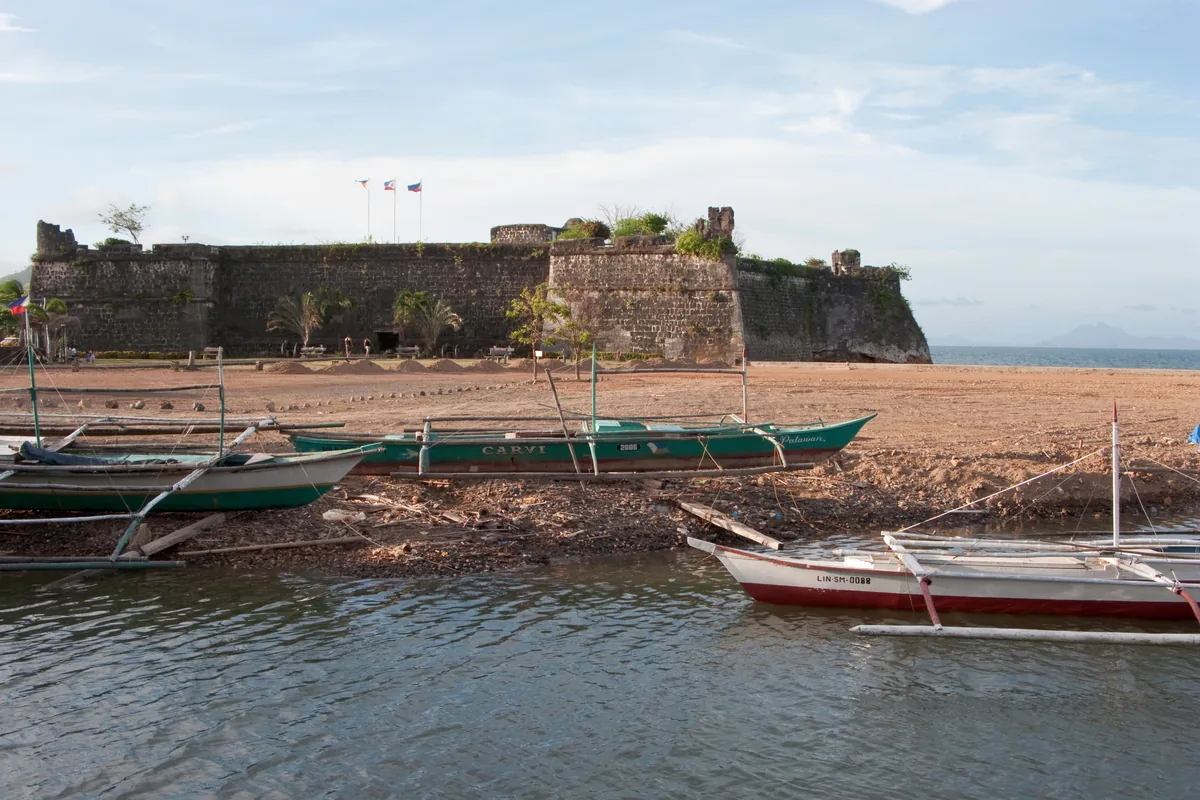
North-eastern mainland Palawan, on Taytay Bay — on the highway between Puerto Princesa and El Nido
Taytay is the town most Palawan itineraries drive straight past without knowing what it is. It was the capital of the whole province long before Puerto Princesa was, and its Spanish fort still stands on the shore in the middle of town. It also sits on the national highway between Puerto Princesa and El Nido — so for most travellers this is not a detour at all, it is a stop on a drive they were already making.
Taytay is a municipality on the north-eastern coast of mainland Palawan, bounded by El Nido to the north, San Vicente and Dumaran to the south, the South China Sea to the west and the Sulu Sea to the east — so it spans the full width of the island.
It is the province’s former capital. Formally founded in 1623, it became the capital of the province of Calamianes — the whole of what is now Palawan — in 1818, and of the province of Castilla, covering northern Palawan, in 1858.
Fuerza de Santa Isabel, the stone fort on the shore in the town centre, was begun in 1667 under the Augustinian Recollect fathers and completed in 1738, and was named in honour of Queen Isabella II of Spain. Its small chapel and its cannons are still intact, and it is looked after by the municipal government.
Malampaya Sound, on the municipality’s western side, is a protected area and one of the places the critically endangered Irrawaddy dolphin is found.
The town has its own airfield — Cesar Lim Rodriguez Airport, commonly called Taytay Airport (IATA: RZP), in Barangay Sandoval. It is owned by the Province of Palawan and named after a Taytay native who donated part of his land for it.
Island resorts off the coast, including Apulit Island, sit in Taytay Bay and are reached by boat from the mainland rather than by road.
We do not run this boat, so we will not pretend we can refund someone else’s sailing — but we will not leave you paying for a vehicle that has nowhere to be either. If the crossing is suspended or your boat does not go, the transfer we quoted is re-timed or rebooked for when it does.
Arriving or leaving by boat? Tell us in the notes which crossing you are booked on and the vehicle is timed to meet it rather than to a clock, with the pickup point and time named on the written confirmation we send before you travel. We do not track a sailing the way we track a flight, so if the boat runs late or you are moved to another one, message us while it is happening and we re-time the driver rather than leaving you to sort it out at the pier.
Airport pickups are met in the arrivals area with a name board rather than at the kerb, and the written confirmation sent before you travel carries the driver and vehicle details.
The departure leg is quoted the same way: send the flight you are catching and the pickup is worked back from it rather than guessed, and where the timing is tight we will say plainly whether it works.
If the name board is not there when you land, stay in the arrivals area and message us rather than leaving the terminal or taking a taxi — the written confirmation sent before you travel carries the driver and vehicle details, so save it offline and use it. We would rather sort it out while you are standing there than hear about it afterwards.
Everything we arrange is in English, and we are the English-speaking end of it on the day as well as before it — if something moves, message us rather than trying to settle it at the roadside. We do not promise a particular driver’s fluency; instead the written confirmation carries the pickup, the driver and vehicle details and the shape of the day, so it is settled in writing rather than negotiated at a kerb.
The vehicle is sized around the whole load, not the head count alone, so send the real bag count with the group size: where the luggage is what one vehicle cannot comfortably take we go up a class, or run more than one vehicle kept together on a single booking, rather than finding out at the kerb.
Stopping somewhere on the way is normal here, not a separate booking: the vehicle and driver stay with you through the stop and your luggage stays aboard, so list the stops in order on the quote form and we plan the day around them rather than leaving it to the roadside.
We publish facts, not fares. Prices depend on the vehicle or boat, your group size, waiting time and the season, so every trip is quoted individually — free and with no obligation.
What we can quote for Taytay
Private transfers between Puerto Princesa city or the airport (PPS) and Taytay, in either direction
A Taytay stop built into a Puerto Princesa → El Nido transfer, so the fort is a break in the drive rather than a separate trip
Onward private transfers between Taytay and El Nido, Port Barton or San Vicente
Road transfers to the Taytay Bay jetty for island-resort boat hand-offs, timed to the boat you are booked on
Cesar Lim Rodriguez Airport (RZP) pickups and drop-offs
Vehicles sized for groups travelling north with multi-day luggage
On the north-eastern coast of mainland Palawan, on Taytay Bay. The municipality is bounded by El Nido to the north, San Vicente and Dumaran to the south, the South China Sea to the west and the Sulu Sea to the east, so it spans the full width of the island.
Do you pass through Taytay on the way to El Nido?
Yes. Taytay sits on the national highway between Puerto Princesa and El Nido, so a northbound road transfer runs through it. That means a stop at the fort can be built into a transfer you are already taking, rather than booked as a separate trip — just tell us when you ask for the quote.
What is there to see in Taytay?
Fuerza de Santa Isabel, the stone fort on the shore in the town centre. It was begun in 1667 under the Augustinian Recollect fathers, completed in 1738 and named in honour of Queen Isabella II of Spain, and its small chapel and cannons are still intact. Taytay was also the capital of the province from 1818, long before Puerto Princesa.
Is there an airport at Taytay?
The town has its own airfield — Cesar Lim Rodriguez Airport, commonly called Taytay Airport (IATA: RZP), in Barangay Sandoval, owned by the Province of Palawan. Most travellers still reach Taytay by road from Puerto Princesa (PPS), and we quote that transfer either way; we also cover RZP pickups and drop-offs if you are flying in.
How do you reach the island resorts in Taytay Bay?
By boat from the mainland, not by road — island resorts off the coast, including Apulit Island, sit out in Taytay Bay. We quote the road leg to the Taytay Bay jetty and time it to the boat you are booked on, so the drive and the crossing line up.
Anything specific to your dates, group or pickup point is answered on the quote — that is where the actual vehicle, timing and fixed all-in price come from.