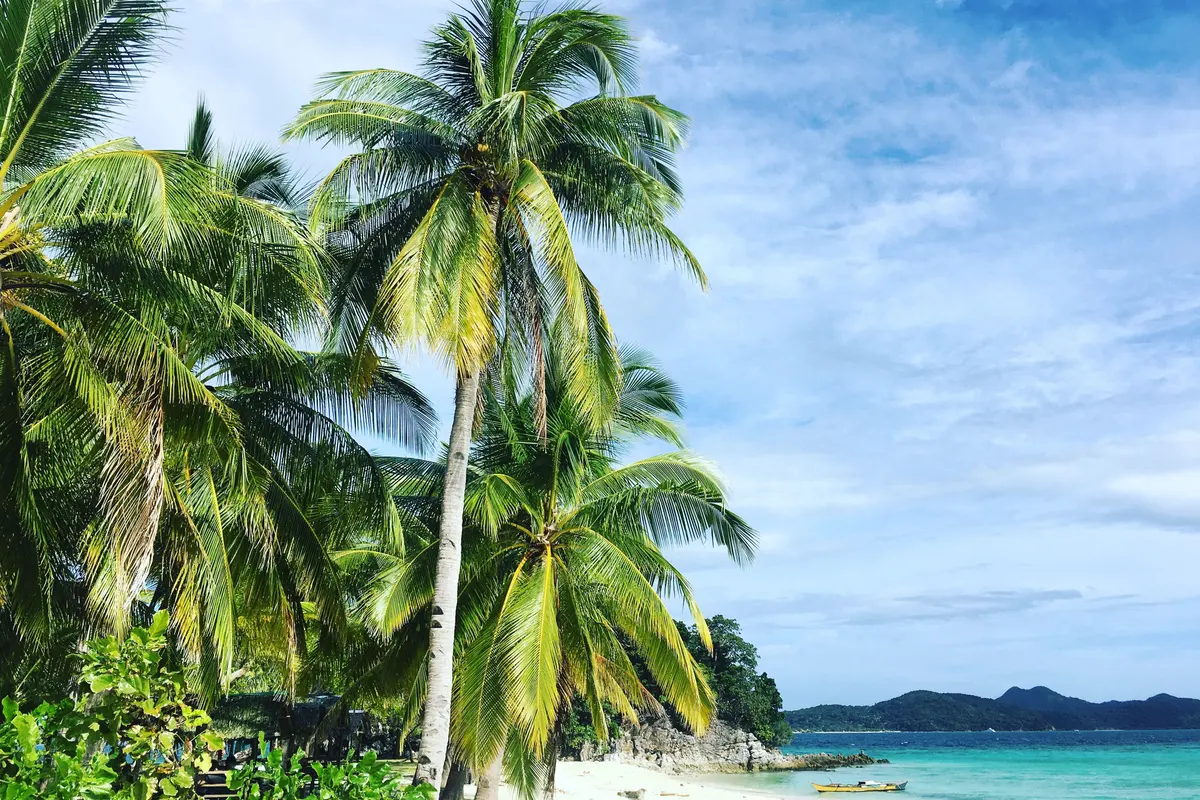
Northern Palawan’s island group — Busuanga, Coron, Culion and Linapacan — reached through Francisco B. Reyes Airport (USU) on Busuanga Island
Almost everyone flying into the Calamianes lands in the same place, and almost nobody calls it the same thing. Francisco B. Reyes Airport is coded USU, is commonly known as Busuanga Airport, sits inside the municipality of Coron, and is the gateway for resorts scattered across several separate islands. That is why “Coron airport transfer” is not yet a plan: a stay on Busuanga Island is a road transfer, while Culion or a smaller offshore island needs a boat after the road leg. Tell us the actual resort, not only “Coron”, and we quote the whole arrival — vehicle, timing and boat hand-off — as one connected journey.
Francisco B. Reyes Airport carries the IATA code USU and the ICAO code RPVV. It is commonly called Busuanga Airport, it stands within the municipality of Coron on Busuanga Island, and it is shared with the neighbouring municipality of Busuanga — so “Busuanga Airport”, “Coron Airport” and “USU” all name the same single terminal.
The airport is named after Francisco B. Reyes, Mayor of Coron from 1936 to 1939, who donated the land the airport complex stands on.
The Civil Aviation Authority of the Philippines classes it as a Class 2 principal (minor domestic) airport, with one concrete runway of 1,225 metres. It is a domestic gateway, so an international visitor connects through a Philippine hub before flying in.
The Calamian Islands are a group, not a single place: Busuanga, Coron, Culion and Linapacan, plus numerous smaller islands, spread over roughly 1,800 km² of sea.
Busuanga Island is the largest island in the Calamian group and the second-largest in Palawan province after Palawan island itself, at about 890 km². Its western part is the municipality of Busuanga and its eastern part the municipality of Coron.
Coron town sits on Busuanga Island. Coron Island is a different island — the third-largest in the group, ringed by limestone cliffs and karst and holding eleven inland lakes, among them Kayangan and Barracuda. It is reached by boat, never by road.
Coron municipality covers 689.10 km² across 23 barangays, had a population of 69,439 at the 2024 census, and uses postal code 5316. Giving a driver the barangay as well as the resort name is what turns “Coron” into an address.
Culion is a separate island municipality — Culion Island plus 41 smaller islands, 499.59 km², population 23,985 at the 2024 census, postal code 5315. A Culion resort always needs a boat leg after the airport road transfer.
Culion was a leprosarium from 1906 under the American colonial administration and was declared leprosy-free by the World Health Organization in 2006. Its heritage town is a destination in its own right, not only a transfer stop.
The Japanese wrecks that made Coron Bay a diving destination were sunk there by a United States Navy air attack on 24 September 1944. The bay is a natural anchorage beside Coron town, so wreck days run from the town side of Busuanga Island.
Calauit Island, at the far western end of the group, holds a wildlife sanctuary established in the 1970s with African species including giraffes and zebras, alongside endemic Philippine wildlife such as hornbills, sea turtles and dugongs. It is a full land-and-boat day from Coron town, not a short hop.
The Calamian Tagbanwa are an indigenous people distinct from the Tagbanwa of mainland Palawan. They hold a Certificate of Ancestral Domain Title granted in 2004 covering 24,520 hectares, which includes Coron Island — so access there follows the community’s rules, not a resort’s.
We do not run this boat, so we will not pretend we can refund someone else’s sailing — but we will not leave you paying for a vehicle that has nowhere to be either. If the crossing is suspended or your boat does not go, the transfer we quoted is re-timed or rebooked for when it does.
Arriving or leaving by boat? Tell us in the notes which crossing you are booked on and the vehicle is timed to meet it rather than to a clock, with the pickup point and time named on the written confirmation we send before you travel. We do not track a sailing the way we track a flight, so if the boat runs late or you are moved to another one, message us while it is happening and we re-time the driver rather than leaving you to sort it out at the pier.
Travelling with dive kit, a board bag or other bulky equipment? Say so on the quote form — it travels inside the vehicle with you, so it is the load rather than the head count that decides which vehicle we send.
Airport pickups are met in the arrivals area with a name board rather than at the kerb, and the written confirmation sent before you travel carries the driver and vehicle details.
The departure leg is quoted the same way: send the flight you are catching and the pickup is worked back from it rather than guessed, and where the timing is tight we will say plainly whether it works.
If the name board is not there when you land, stay in the arrivals area and message us rather than leaving the terminal or taking a taxi — the written confirmation sent before you travel carries the driver and vehicle details, so save it offline and use it. We would rather sort it out while you are standing there than hear about it afterwards.
Everything we arrange is in English, and we are the English-speaking end of it on the day as well as before it — if something moves, message us rather than trying to settle it at the roadside. We do not promise a particular driver’s fluency; instead the written confirmation carries the pickup, the driver and vehicle details and the shape of the day, so it is settled in writing rather than negotiated at a kerb.
If you are the one running late — a slow checkout, a breakfast that ran on — message us while it is happening rather than afterwards, using the reply path on the written confirmation sent before you travel: on the morning it is something we can relay to the driver and re-time around where the day allows, and afterwards it is not. We publish no waiting window and nothing is settled in cash at the kerb, but we will not pretend a delay is free of consequence either: a leg somebody else holds — a permit slot, a ferry, a flight — keeps its own clock, and a long hold can re-price the day, which we would tell you rather than spring on you.
The vehicle is sized around the whole load, not the head count alone, so send the real bag count with the group size: where the luggage is what one vehicle cannot comfortably take we go up a class, or run more than one vehicle kept together on a single booking, rather than finding out at the kerb.
Not booked your accommodation yet? Ask anyway — the town or the area you are aiming for is enough for us to quote the leg and tell you whether it works. The exact property belongs to the confirmation, not the enquiry: send it by reply as soon as you have it, and if the final address changes the trip materially we re-quote it rather than finding out on the day.
Stopping somewhere on the way is normal here, not a separate booking: the vehicle and driver stay with you through the stop and your luggage stays aboard, so list the stops in order on the quote form and we plan the day around them rather than leaving it to the roadside.
This is a long run on the road, and stopping on the way is a normal part of one: the vehicle is yours for the leg rather than a shared van on its own turnaround, so the driver can pull over where it is safe for a toilet, for food or just to get out of the seat, with your bags staying aboard. If anyone travelling needs to stop more often, needs to eat at a set time, or travels badly on winding roads, say so in the notes on the quote form and we plan the leg around it.
A private transfer has no second van behind it, so it is fair to ask what happens if this one fails on the road: it stays ours to sort out rather than becoming yours — the driver reports it to us rather than leaving you to work it out, nothing is settled at the roadside, and where part of the trip did not happen the rebook-or-refund position on our terms applies for our reason exactly as it does for the weather.
We publish facts, not fares. Prices depend on the vehicle or boat, your group size, waiting time and the season, so every trip is quoted individually — free and with no obligation.
What we can quote for Busuanga & Calamianes resorts
Francisco B. Reyes Airport (USU) transfers to Coron town and Busuanga Island resorts
Road-and-boat arrival plans for resorts on Culion and smaller Calamian islands
Private cars and vans sized around your group and luggage
Return transfers coordinated around the flight and the resort’s boat hand-off
Land days across Busuanga Island, including the western end towards Calauit
Culion heritage-town visits built into a Calamianes stay rather than bolted on
Multi-stop stays combining a Calamianes resort with Coron town or El Nido
Yes — there is one airport and three names for it. Francisco B. Reyes Airport (IATA USU, ICAO RPVV) is commonly called Busuanga Airport, stands within the municipality of Coron on Busuanga Island, and is shared with the neighbouring municipality of Busuanga. If a booking says Busuanga, Coron or USU, it is the same terminal.
Which airport do Calamianes resorts use?
Francisco B. Reyes Airport (USU) on Busuanga Island. It is the air gateway for Coron town and for resorts across the Calamianes. The Civil Aviation Authority of the Philippines classes it as a Class 2 principal (minor domestic) airport with a single 1,225-metre runway, so an international visitor connects through a Philippine hub before flying in.
Which islands are the Calamianes?
Busuanga, Coron, Culion and Linapacan, together with numerous smaller islands, spread across roughly 1,800 square kilometres of sea in northern Palawan. It is a group rather than one destination, which is why an arrival plan starts with the resort name rather than the island group.
What is the difference between Coron town and Coron Island?
Coron town is on Busuanga Island and is where the road from the airport goes. Coron Island is a separate island — the third-largest in the group — with limestone cliffs, karst and eleven inland lakes including Kayangan and Barracuda, and it is reached by boat. A great many arrival mix-ups come from those two sharing a name.
Will I need a boat as well as a vehicle?
It depends on the resort. A stay on Busuanga Island itself is reached from the airport by road, while resorts on Culion or a smaller offshore island need an onward boat connection after the road leg. We plan both legs together so the hand-off is fixed rather than improvised on the day.
Why is “Coron airport transfer” not enough detail?
Because the name covers several different places. Coron town is on Busuanga Island, Coron Island is a separate island reached by boat, and Culion is a separate island municipality entirely. Naming the actual resort and its barangay is what identifies the final leg — Coron municipality alone spans 689.10 square kilometres and 23 barangays.
How do I get to Culion?
By road from the airport and then by boat. Culion is its own island municipality — Culion Island plus 41 smaller islands, postal code 5315 — so there is no road route from Busuanga Island. Tell us the property and we quote the vehicle and the crossing as one arrival.
Is Culion worth a visit in its own right?
Many travellers think so. Culion was a leprosarium from 1906 under the American colonial administration and was declared leprosy-free by the World Health Organization in 2006, and its heritage town reflects that history. It works as a day out of Coron or as a stop built into a longer Calamianes itinerary.
Can I visit Calauit and the wildlife sanctuary from Coron town?
Yes, but plan it as a full day rather than a short hop. Calauit Island lies at the far western end of the group and the sanctuary — established in the 1970s with African species such as giraffes and zebras, now alongside endemic Philippine wildlife including hornbills, sea turtles and dugongs — takes both a long land leg across Busuanga Island and a boat.
Where do the Coron Bay wreck dives start from?
From the Coron town side of Busuanga Island. Coron Bay is a natural anchorage beside the town, and the Japanese ships that make it a wreck-diving destination were sunk there by a United States Navy air attack on 24 September 1944. If you are diving, we usually quote transfers to a town-side base rather than a far-island resort.
Can you coordinate the return with my flight and the resort boat?
Yes. Return transfers are planned around both the flight and the resort’s boat hand-off, so the connection is agreed in advance rather than sorted out on the morning you leave.
Anything specific to your dates, group or pickup point is answered on the quote — that is where the actual vehicle, timing and fixed all-in price come from.